
If you’ve ever wondered whether you’re “trans enough,” I want you to know I see you, and I’m glad you’re here. Many of you write to me with some version of the same worry: I’m not ready to start hormones. I’m not ready to be out. I don’t want any kind of surgery. Does that mean I’m not valid? That question comes from a real, tender place, and you deserve a real answer.
There is no such thing as “trans enough.” Being trans is about your inner sense of gender, not about hormones, surgery, or being out. Medical and surgical steps are treatment options for dysphoria, not a test of whether your identity is valid.
I’ll be honest: I laugh a little at the idea of “trans enough,” because it’s such a ridiculous concept. But I know it hurts when it’s aimed at you, so let’s break down where it comes from and why it doesn’t hold up.
What “Trans” Actually Means
Let’s start with the word itself. Trans is short for transgender, and the prefix trans comes from Latin, meaning “across” or “beyond.” In this context, it describes someone whose gender identity differs from the gender they were assigned at birth. Notice that this is a description of identity. It says nothing about what someone’s body looks like, what they wear, or what steps they have or haven’t taken.
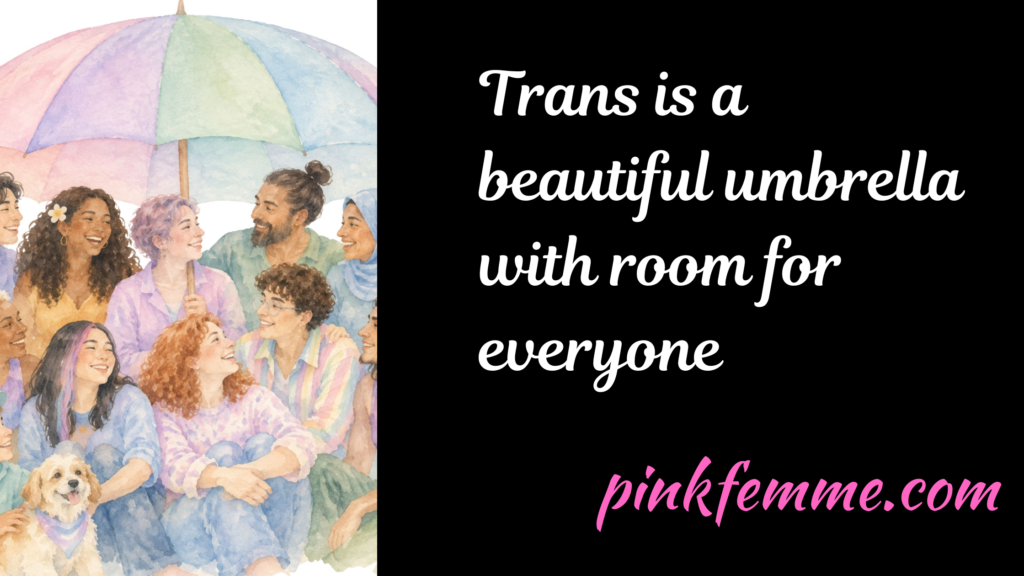
Transgender is also an umbrella term, and a roomy one. Under it you’ll find trans women, trans men, trans masculine and trans feminine people, nonbinary people, genderqueer people, genderfluid people, agender people, and many others. Some folks use one of these words, some use several, and some prefer to simply say “I’m trans.” Some skip labels altogether, and that’s fine too. Language is meant to serve you, not confine you.
I like to think of these words as tools for connection. When you say “I’m a trans woman” or “I’m nonbinary,” you’re handing someone a small piece of your inner world so they can understand you a little better. Many people also find that the right word brings tremendous relief, like finally seeing your reflection clearly. And if the words you use change over time as you learn more about yourself, that’s growth, not inconsistency. Plenty of us have worn different labels at different seasons of our lives.
The same goes for cisgender, which describes a person whose gender aligns with the one they were assigned. Having a word for that matters, because it reminds us that everyone has a relationship to their gender. Cis people have one too; it just tends to go unnoticed because society treats it as the default.
It also helps to untangle gender identity from a few things it often gets lumped in with. Gender identity is not the same as sexual orientation, which is about who you’re attracted to. Trans people can be straight, gay, bi, queer, asexual, or anything else. It’s also not the same as gender expression, which is how you present yourself through clothing, voice, mannerisms, and style. A trans woman might love flannel and hiking boots, and a cis woman might wear a suit every day. Neither one changes who they are inside.
Finally, it’s worth remembering that gender is understood differently across the world. Many cultures have long recognized genders beyond two, from the hijra of South Asia to the two-spirit people of some Indigenous North American nations. Trans people have always existed. Our vocabulary just keeps evolving as we find better ways to describe our experiences.
At its heart, gender identity is that deep, inner sense of how you see yourself. It can’t be measured from the outside, and the only person who can name it is you.
Gender Identity vs. Gender Dysphoria
These two are often confused, so let me gently pull them apart. Gender identity is who you are. Gender dysphoria is how you may feel when the world, or your body, doesn’t reflect who you are. One is a core sense of self. The other is an experience, and not everyone has it.
Dysphoria is a psychological response, and I often describe it as a distress signal, like an alarm going off inside you. It shows up when there’s an incongruence between your gender identity and the gender you were assigned. For some people, it centers on the body: certain physical features feel foreign or painful. For others, it’s more social, like being addressed with the wrong name or pronouns, or being read by strangers in a way that doesn’t match how you see yourself. Many people experience a mix of both. It can feel like a quiet, constant ache, or it can hit in sudden waves, triggered by a mirror, a photograph, a medical form, or an offhand comment.
Dysphoria also isn’t fixed. It can change with your circumstances, your stress levels, and the stage of life you’re in. Some days it’s loud, and some days it’s barely there. If yours fluctuates, that doesn’t make it less real, and it doesn’t make your identity any less certain.
Because dysphoria is painful, many people seek out gender transition as a way to ease it. I like to remind people that transition is a broad word with many doors. It can be social, like changing your name, pronouns, hair, or wardrobe. It can be legal, like updating documents. It can be medical or surgical. It can even be spiritual, such as finding ceremonies, practices, or communities that honor who you are. Some people open one door, some open several, and some open none. We call these steps treatments because their purpose is to relieve distress, and the right combination is whatever brings you relief and peace.
Now, here’s something I want you to hear clearly: you can be trans without ever experiencing dysphoria. Some people feel no distress at all. What draws them toward transition is euphoria, that bright, joyful sense of rightness when something finally fits, like hearing your chosen name spoken warmly or catching your reflection and thinking, there I am. Others simply know that a particular step feels more aligned with who they are. Both paths are valid. The reasons we move toward transition are as varied as we are.
And what about people whose dysphoria fades as they transition? Their identity doesn’t vanish when the pain does. If the alarm quiets down, the person is still exactly who they were all along. The distress was never the source of the identity. It was only ever a signal that something needed care.
I’ll admit this is where my professional heart lives. My expertise is in gender identity and in the many ways we can ease dysphoria, and the most important thing I’ve learned is this: identity and treatment are two different things. One is who you are, and the other is what you may choose to do to feel more at home. If you’re struggling with dysphoria, please know that support exists, and a therapist experienced in gender-affirming care can help you find your own path, at your own pace.
Why “Trans Enough” Doesn’t Hold Up
Whenever someone says you’re not trans enough, I invite you to ask a simple question: enough by whose measure? The phrase assumes there’s a finish line, a standard everyone agreed on, and a person qualified to judge whether you’ve crossed it. No such standard exists. No one holds a clipboard, and no one gets to decide how much of your inner truth counts.
Saying someone isn’t trans enough implies there’s a set, correct way to experience gender. That’s impossible. Your relationship to your gender is personal and subjective, shaped by your culture, your socialization, your upbringing, your traumas, and so much more. Two people can have wildly different stories and still share the same truth: the gender they were assigned doesn’t fully fit who they are. Your story doesn’t have to look like anyone else’s to be real.
Notice, too, that the measuring stick keeps moving. One person says you aren’t trans enough unless you’ve started hormones. Another says hormones aren’t enough without surgery. Someone else says you must have known since childhood, or have a certain look, or a certain voice. Every person who draws the line draws it in a different place, and it’s usually right where their own journey happens to stand. A standard that changes with whoever is speaking isn’t really a standard at all.
We can speak in generalities. Transgender broadly describes someone who isn’t comfortable with their assigned gender. Beyond that, no one can say exactly what trans-ness has to look like. There’s no blood test, no scan, no questionnaire that settles it. The only real expert on your gender is you.
I also find it telling that we never ask cisgender people to prove themselves this way. No one asks a woman whether she’s cis enough, or quizzes a man about whether he feels masculine enough to deserve the word. Cis people are simply believed when they describe themselves. “Trans enough” asks trans people to hand over evidence that no one else is ever asked for, and that double standard alone should make us question the whole idea.
Think about it this way, too: many cisgender people get facial feminization procedures. Does that make them trans? Of course not. Cis women have breast augmentations, cis men take testosterone, and plenty of cis people use hormones or have surgeries that reshape their bodies. No one looks at those choices and declares a change of gender identity. Surgery and hormones don’t define identity, which shows how quickly the “trans enough” logic falls apart. If the same procedures can belong to a cis person’s story, they can’t be what makes someone trans.
So the next time those two words creep into your mind, whether from someone else or from your own inner critic, I hope you’ll gently set them down. You don’t have to prove, perform, or pass any test to be exactly who you are.
Where Gatekeeping Comes From
Gatekeeping is a very human habit, and it shows up in nearly every group people have ever formed. Professions have their unwritten rules about who counts as a “real” member. Religions argue over who is truly faithful. Fandoms quiz each other on trivia. Wherever people gather around something that matters deeply to them, someone eventually appoints themselves the doorkeeper. The trans community is no exception. We’re a community of human beings, and we carry our human flaws along with our courage.
Walls usually exist to exclude, and exclusion usually exists to create a hierarchy: I’m better than you. When a group is built on that foundation, belonging stops being something you receive and becomes something you have to earn.
“You’re not trans enough” creates exactly that kind of ladder. It says, “I’m going through all the steps, so I’m more trans than you.” But think about what’s really being said underneath. It treats an identity like a rank, where the person who has done the most sits at the top and everyone else is left climbing. It turns a shared experience into a competition, and no one wins a competition like that.
I want to be gentle but honest about why people build these hierarchies, because understanding the “why” can take some of the sting out. Sometimes it’s about feeling better about themselves. If someone has endured a painful, expensive, exhausting transition, it can feel reassuring to believe that the sacrifice made them more authentic. Sometimes they want to justify their own decisions, and they need everyone else’s path to look like their own in order to feel certain they chose correctly. And sometimes the gatekeeper is acting out of fear. Many of us were questioned, doubted, or turned away by doctors, family, and strangers, and some people absorb that suspicion so deeply that they start aiming it at others, as though protecting the community from “impostors” will somehow make it safer.
There’s also a painful history here. For many years, access to medical care required a person to fit a narrow, scripted story, and some people learned to recite what gatekeepers wanted to hear in order to receive the help they needed. That kind of pressure leaves marks. It can leave people believing there is a “correct” way to be trans, and passing that belief along without even realizing it. I don’t say this to excuse the behavior, only to help us see where it grows from.
And there’s a quieter harm that doesn’t get talked about enough. The people most often excluded by the “you must transition” idea are frequently those who have the least say over their own circumstances. Some can’t afford hormones or surgery. Some live in places where care is out of reach, or where coming out could cost them their home, their job, or their safety. Some have health conditions that make certain treatments unsafe. Some are simply taking their time, which is a perfectly wise thing to do. Telling any of these people they aren’t trans enough doesn’t protect anyone. It adds a layer of rejection on top of the obstacles they already face.
When someone says trans means you must go through medical or surgical transition, they’re wrong, and I’ve said so many times. That idea excludes everyone who isn’t pursuing those paths, whether by choice, by circumstance, or because those services simply aren’t part of their plan. It also quietly hurts the people who are transitioning, because it implies their steps are a requirement and not a personal decision made for their own reasons.
So if someone has ever tried to hold a gate shut in front of you, please hear me: that gate was never theirs to guard. You don’t need a permission slip to belong. A healthy community opens its doors wide, makes room at the table, and trusts people to know their own hearts.
Medical and Surgical Steps Are Tools, Not Measures
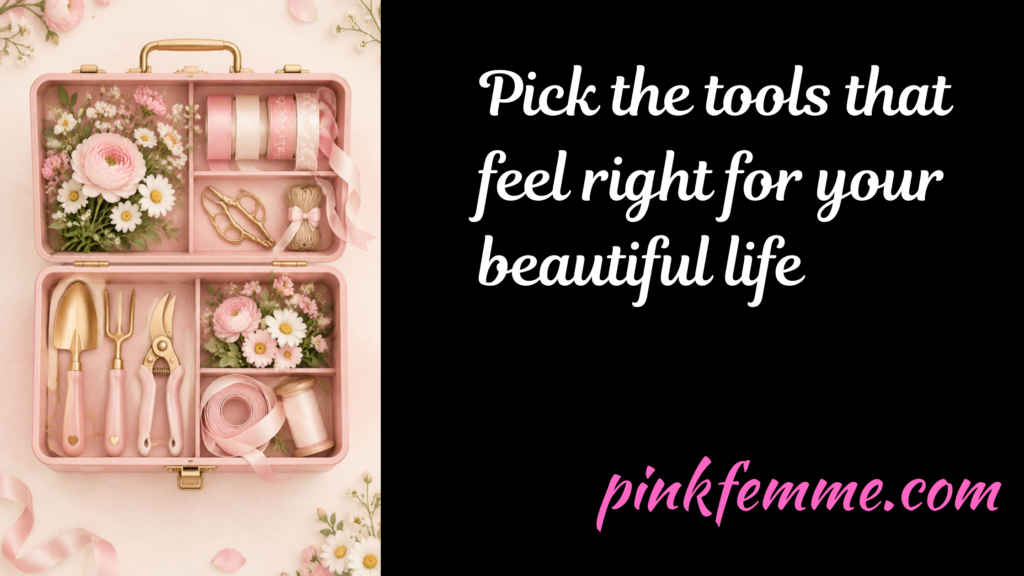
I like to think of medical and surgical steps as tools in a toolbox. A carpenter doesn’t use every tool for every project, and nobody questions whether she’s a “real” carpenter because she never needed a particular saw. The tools you reach for depend on what you’re building, and you’re the only one who knows the shape of your own life.
People choose medical or surgical steps because they align with their goals. Maybe they want to feel more confident in their body, ease dysphoria, or gain physical characteristics that match their gender. Those goals are deeply personal, and they’re not a measure of strength or authenticity. Every person’s list of goals looks different, and every list is allowed to be short, long, or even blank.
It’s also worth remembering that “medical and surgical” isn’t one single path. There are many options, and they’re not all-or-nothing. Some people take hormones for a while and stop. Some choose a single procedure, some choose several, and some feel complete without any at all. Others want certain changes but are waiting for the right time, the right surgeon, the right support system, or the right season of life. A decision to pause or to skip a step isn’t a failure of courage. Often it’s a thoughtful act of self-knowledge.
There’s also the practical side, which doesn’t get nearly enough attention. These steps can come with real barriers: cost, long waiting lists, limited access to knowledgeable providers, travel, insurance denials, and recovery time away from work or family. Some people have health conditions that make certain treatments risky. Others have caregiving duties or jobs that can’t be set aside. When someone’s access is limited by circumstances far outside their control, it would be cruel to read that as a sign their identity is lacking. Resilience looks different for each of us, and sometimes simply getting through the day as yourself is the bravest step there is.
And here’s something I’d like you to hold onto: neither strength nor authenticity is measured by how much you endure. A hard, painful transition doesn’t make someone more trans, and a gentle one doesn’t make someone less. The size of your journey tells us nothing about the truth of who you are. Whether you take many steps, one step, or none, you are standing in the same truth.
I also want to say something to those who are pursuing medical or surgical care. Your choices are valid and beautiful, and they deserve respect without being held up as the standard everyone else must meet. Making them a requirement would take away what makes them meaningful, which is that they are chosen, freely and for your own reasons.
Saying you’re not trans enough without surgery is the same kind of thinking as saying you’re not a woman unless you menstruate or can give birth. It takes something deeply felt and reduces it to a few physical elements. Think of all the women who don’t menstruate or can’t give birth, whether because of age, illness, a medical condition, or simply how their bodies are made. We would never dream of telling them they’re less womanly. That kind of reduction is just as ridiculous, and just as invalidating, when it’s pointed at trans people.
Your identity was never held in your body parts or your medical chart. It lives in your heart, in the way you know yourself. Surgeries and hormones can be wonderful tools for those who want them, but they were never meant to be a measuring tape, and I hope you’ll never let anyone hold one up against you.
If You’ve Been Made to Feel “Less Than”
I’ve heard from so many of you who feel you can’t join support groups or be part of the trans community because you aren’t at a stage of life where you’re ready for services, or because circumstances are keeping you from them. You feel that if you aren’t doing everything others are doing, you’re somehow less. Please know that I’m not just reading your words. I’m feeling the weight behind them, and I wish I could sit beside you with a warm cup of tea and listen.
You’re not less. Not even a little.
I want to name what that feeling can look like, because sometimes it’s hard to recognize from the inside. It might be the voice that whispers maybe I’m just confused, or I’m probably overreacting, or real trans people would have done more by now. It might be hovering at the edge of an online group, reading everyone’s posts but never daring to write your own. It might be feeling like an impostor in your own life, waiting for someone to discover you don’t qualify. If any of this sounds familiar, you’re not alone, and none of it means something is wrong with you. It means you’ve absorbed a message that was never true.

Part of what makes this so painful is that it can arrive at the very moment you most need support. When you’re questioning, exploring, or quietly holding your truth with no one to share it with, being told you haven’t done enough is a particular kind of heartbreak. Isolation can make the doubt grow louder, while connection tends to soften it. That’s why I hope you’ll consider reaching out, even in small ways. Reading stories from others at your own pace is a way of participating. So is listening in on a conversation, or sending a single message to one kind person. You don’t have to speak up, show up, or be “out” to deserve a seat. There are spaces, online and in person, whose entire purpose is to welcome people exactly where they are, including those who are only beginning to ask the questions.
Trans identity is simply an innate, felt sense that you’ve diverged from the gender you were assigned. You may have known in childhood. You may have realized during puberty or later in adulthood. You may have lived comfortably with your assigned gender for most of your life and then found that it no longer felt aligned. Every one of those paths is valid.
I’d add that there’s no deadline either. Some people come to this understanding at seven, some at seventeen, and some at seventy. Realizing it later doesn’t mean it wasn’t real all along, and it doesn’t mean you wasted time. Often it means you were doing your best with the information, language, and safety you had. Many of us spent years without the words, or in places where the words weren’t safe to say out loud. Finding them now is not late. It’s right on time for you.
And if your path includes a long pause, that’s valid too. Perhaps you’re waiting for a safer home, a steadier job, a supportive partner, or a calmer season. Perhaps you’re simply sitting with yourself, getting to know who you are before you decide what, if anything, to do next. Taking your time is not the same as being unsure, and it’s certainly not the same as being less.
Transgender is a huge umbrella, and you belong under it. It’s wide enough for the person who transitions quickly and the person who transitions slowly, for the one who is out to everyone and the one who is out to no one, for the one who takes every step and the one who takes none.
People who insist there’s a “trans enough” are building boxes out of their own projections and limitations. When it comes to identity, and especially gender identity, there are no boxes. We’re all individuals with different experiences, and the beauty of that is that no two stories need to match.
So if you take nothing else from this section, I hope you’ll take this: you don’t have to wait until you’re “ready enough,” “sure enough,” or “far enough along” to feel worthy of community and kindness. You’re worthy right now, as you are, on whatever step of the journey you’re standing on. And if no one has told you lately, I’m so glad you’re here.
I’d Love to Hear From You
This is the part of the conversation I look forward to most, because your voices are what make this community feel like a community. I’m not just saying that. When I read your comments, I’m reminded that no one is walking this path alone, even on the days it feels that way.
So let me ask you directly. Have you ever been told by someone in the community that you’re not trans enough? How did that feel in the moment, and how does it sit with you now? Maybe it came from a stranger online, a fellow member of a support group, or even a well-meaning friend. Maybe it came from the quiet voice inside your own head. If you’re comfortable sharing, I’d love to hear what was said and how you carried it.
I’d also love to know what you think about the idea that you have to go through medical or surgical transition to identify as transgender. Where do you think that belief came from for you? Has your view changed over time? If you’ve found a way to make peace with it, or you’re still working through it, your perspective could be exactly what another reader needs to see today.
A few gentle thoughts before you write. You don’t need to share your name, your story in full, or anything that doesn’t feel safe. A single sentence is welcome, and so is a long, winding reflection. There’s no right way to comment, just as there’s no right way to be trans. And if you’re reading this quietly, not ready to type a word, that’s perfectly okay too. Your presence here counts.

If something someone else has shared resonates with you, consider leaving a kind word in reply. You never know how much a small bit of encouragement can mean to a person who has been made to feel “less than.” Many of us have found our first real sense of belonging in a comment section, in a stranger’s warm reply that said, me too.
Please share your thoughts in the comments below. I love reading every one of them, and they truly do shape what I talk about next.
Thank you for spending this time with me. I’ll see you next time. Take care of yourselves, be gentle with your hearts, and remember that you are already enough.
Final Thoughts
If you take one thing from everything we’ve talked about today, I hope it’s this: you don’t have to earn your place in the trans community. Your identity isn’t measured by whether you’ve started hormones, had surgery, or come out to the people around you. Those are choices, and they’re deeply personal ones. They are tools for easing dysphoria or helping you feel more at home in your body. They are not a test you have to pass.
We’ve walked through a lot together. We looked at what the word “trans” means, how identity and dysphoria are two different things, where the idea of “trans enough” comes from, and why it collapses the moment we examine it. If there’s a thread running through all of it, it’s that your gender is yours. It’s shaped by your own history, your culture, and your experiences, and no one else gets to draw the lines around it. Not a stranger online, not a community member with strong opinions, and not even the critical voice in your own head.
So where do you go from here? Here are a few gentle places to begin.
Start with self-compassion. Offer yourself the same kindness you’d give a dear friend who came to you with these same doubts. You would never tell her she wasn’t trans enough. You’d listen, reassure her, and remind her she’s worthy. You deserve every bit of that tenderness, and it’s okay to practice it slowly. Some days it will come easily, and some days you’ll have to choose it on purpose.
Let your own timeline lead. If you’re not ready for certain steps, or they simply aren’t part of your plan, that’s okay. You might find it helpful to jot down what feels right for you today, not what anyone else expects. A journal, a private note on your phone, or a quiet walk can all help you hear your own voice more clearly. Your answers are allowed to change, and changing your mind is part of knowing yourself, not a sign you got it wrong.
Seek out connection that feels safe. If you’re craving community, look for a support group or space where you’re welcomed as you are, without a checklist. Pay attention to how you feel after spending time there. A good community leaves you feeling lighter, more understood, and more like yourself. If a space leaves you feeling smaller or like you’re auditioning, you’re allowed to walk away and keep looking. The right people exist, and they’re worth finding.
Consider a little professional support. If you’re carrying a lot of distress, or you simply want a steady space to sort through your feelings, a therapist experienced in gender-affirming care can be a wonderful companion on the journey. Therapy isn’t a gate you have to pass through. It’s a place to be heard, and you deserve that.
Be ready for the hard moments. Someone may still tell you that you’re not trans enough. When that happens, remember that their words say far more about their own limitations than about you. You don’t owe anyone a debate or an explanation. You can take a breath, step away, and return to the people who know your worth.
I’d also invite you to pass this kindness along. Whenever you meet someone who is just beginning to find their words, be the one who opens the door instead of holding it shut. That small act of welcome is how a community becomes the safe, warm place we all hope for.
Go at your own pace, trust your inner sense of who you are, and know that you are already enough. I’m cheering for you, always.
If you are looking for more lifestyle-related posts here on Pink Femme, you can find them all here.
If you enjoy reading transgender coming out stories or romance stories with a trans-positive element, take a look at my author page on Amazon where you will find all the novels that I have published so far.
Keep up to date with all my latest femme news with the fabulous Pink Femme Newsletter. Each Monday you’ll receive an email from me that will include a chapter from the novel that I am currently writing. I will also alert you to interesting information from articles that have not yet been published on Pink Femme. The Pink Femme Newsletter is the only place to see chapters from the novels before they are published. Sign up today: PINK FEMME NEWSLETTER.
Thank you for your visit to the Pink Femme website. I’m determined to keep all of the valuable information on here free for anyone to access. No pay-walls. That said, if you are able to help keep the lights on, so to speak, I would really appreciate your support. Here is the Pink Femme Patreon page with a really cheap support tier. Every little bit helps to cover the costs of keeping Pink Femme alive on the internet. Hugs to all of you.
When it comes to my choices for makeup and beauty products, I only use L’Oréal Paris (Available on Amazon). I have really sensitive skin and never once have I had any negative reaction to any L’Oréal product.
References
American Psychological Association. (2015). Guidelines for psychological practice with transgender and gender nonconforming people. American Psychologist, 70(9), 832-864. https://doi.org/10.1037/a0039906
American Psychiatric Association. (2022). Gender dysphoria. In Diagnostic and statistical manual of mental disorders (5th ed., text rev.). American Psychiatric Publishing.
Beischel, W. J., Gauvin, S. E. M., & van Anders, S. M. (2022). “A little bit of sunshine”: Gender euphoria in trans and nonbinary people. International Journal of Transgender Health, 23(3), 274-294.
Bockting, W. O., Miner, M. H., Swinburne Romine, R. E., Hamilton, A., & Coleman, E. (2013). Stigma, mental health, and resilience in an online sample of the US transgender population. American Journal of Public Health, 103(5), 943-951.
Coleman, E., Radix, A. E., Bouman, W. P., Brown, G. R., de Vries, A. L. C., Deutsch, M. B., et al. (2022). Standards of care for the health of transgender and gender diverse people, version 8. International Journal of Transgender Health, 23(Suppl. 1), S1-S259. https://doi.org/10.1080/26895269.2022.2100644
Galupo, M. P., Henise, S. B., & Davis, K. S. (2014). Transgender microaggressions in the context of friendship: Patterns of experience across friends’ sexual orientation and gender identity. Psychology of Sexual Orientation and Gender Diversity, 1(4), 461-470.
Hendricks, M. L., & Testa, R. J. (2012). A conceptual framework for clinical work with transgender and gender nonconforming clients: An adaptation of the Minority Stress Model. Professional Psychology: Research and Practice, 43(5), 460-467. https://doi.org/10.1037/a0029597
Hidalgo, M. A., Ehrensaft, D., Tishelman, A. C., Clark, L. F., Garofalo, R., Rosenthal, S. M., Spack, N. P., & Olson, J. (2013). The gender affirmative model: What we know and what we aim to learn. Human Development, 56(5), 285-290.
Olson, K. R., Durwood, L., DeMeules, M., & McLaughlin, K. A. (2016). Mental health of transgender children who are supported in their identities. Pediatrics, 137(3), e20153223.
Testa, R. J., Habarth, J., Peta, J., Balsam, K., & Bockting, W. (2015). Development of the Gender Minority Stress and Resilience Measure. Psychology of Sexual Orientation and Gender Diversity, 2(1), 65-77. https://doi.org/10.1037/sgd0000081
Recent Posts
A while ago, a friend who had just begun her transition told me, over coffee, about her first attempt to buy a bra. She spent twenty minutes in a fitting room, tangled in straps, trying to reach a...
A few months ago I was getting ready for a dinner with friends, and I'd spent a good twenty minutes trying to nail a perfectly symmetrical cat eye. One wing came out sharp as a blade and the other...