

If you’re reading this and feeling tired—like a deep, bone‑level tired that no amount of sleep seems to fix—I want you to know I see you. So many of us spend years holding our gender at the very front of our minds, constantly checking, adjusting, monitoring, and protecting ourselves. Over time, that constant vigilance can quietly wear us down. Gender identity fatigue is not a failure, and it’s not a sign you’re doing something wrong. It’s often a sign that you’ve been trying very hard for a very long time.
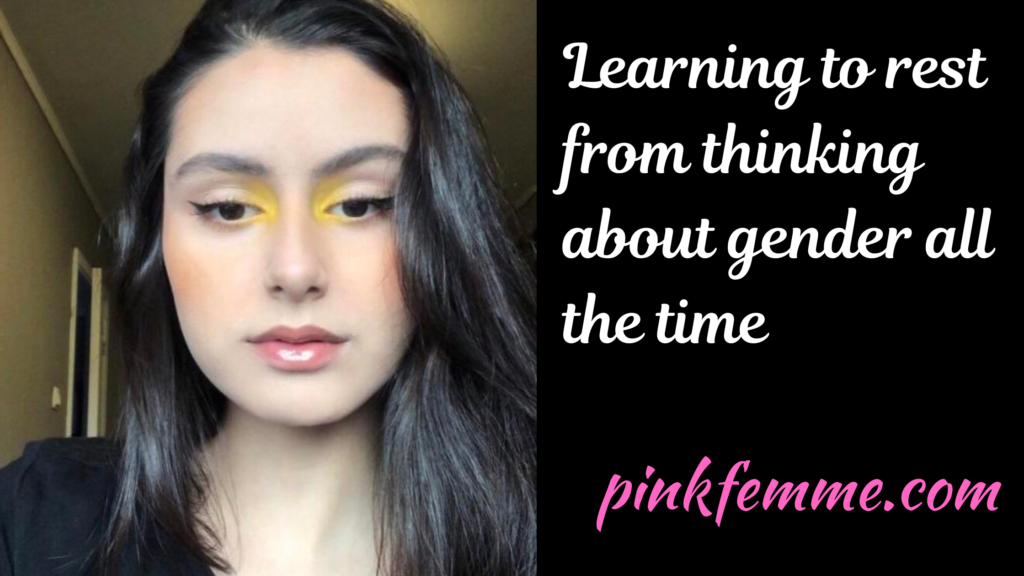
Gender identity fatigue is the emotional and mental exhaustion that comes from constantly thinking about, monitoring, and managing your gender identity. It often shows up as anxiety, self‑doubt, and burnout—even after transition—because your mind and body never get a chance to fully rest.
If that description landed a little too close to home, you’re not alone. In the rest of this article, I want to gently unpack how gender identity fatigue differs from transition burnout, how it affects your body and your life, and—most importantly—what it may be asking you to pay attention to next.
Transition Burnout vs. Gender Identity Fatigue
Before I go any further, I want to pause here and make an important distinction—because these two experiences are often confused, and that confusion alone can make people feel even more overwhelmed. I talk a lot about transition burnout, and while it often overlaps with gender identity fatigue, they are not the same thing, even though they frequently coexist.
Transition burnout is rooted in effort. It comes from the ongoing, repetitive nature of transition-related tasks—the things you have to actively do. Hormones that require constant scheduling and patience. Voice training sessions that demand focus and consistency. Hair removal that stretches on month after month. Appointments, paperwork, waiting periods, plateaus where progress feels painfully slow or nonexistent. None of these are single steps; they’re long-term commitments, and carrying them for years can be deeply draining.
When transition burnout sets in, it often feels like a kind of emotional exhaustion mixed with frustration. You may notice resistance coming up—avoiding appointments, dreading routines you once felt hopeful about, or feeling irritated when transition comes up in conversation. It’s not that transition suddenly feels wrong; it’s that you’re simply worn out from carrying the workload of it for so long.
Gender identity fatigue is different. It’s not so much about the tasks as it is about the mental load. This kind of fatigue comes from constantly thinking about your gender—monitoring it, evaluating it, questioning it, managing it. Even on days when you’re not actively doing anything related to transition, your mind is still busy. Gender stays front and center, running quietly (or loudly) in the background of everything else you do.
This is the exhaustion of awareness rather than action. It’s the tiredness that comes from never fully clocking out—always scanning, always checking in with yourself, always wondering how you’re being perceived or whether you’re “getting it right.” There’s no clear endpoint to that kind of vigilance, which is why it can feel so consuming.
And for many people, these two experiences happen at the same time. You may be physically and emotionally exhausted from the demands of transition and mentally depleted from the constant focus on gender. When they overlap, it can feel like a double weight—one that affects both your energy and your sense of inner peace.
Understanding the difference doesn’t make either one disappear, but it can bring clarity. And sometimes, clarity alone can feel like a small exhale—a reminder that what you’re feeling has a name, a reason, and a context.
What Gender Identity Fatigue Actually Feels Like
Gender identity fatigue often sneaks in quietly. It can show up while you’re actively transitioning, or long after you feel like you’ve reached a place of stability—when, on paper, things are “supposed” to feel easier. Instead of relief, you notice a constant mental hum that never quite turns off.

It sounds like an ongoing inner dialogue that follows you everywhere:
- Am I doing this right?
- Did my voice just shift when I laughed?
- Is my body language giving me away?
- How are they seeing me right now?
These thoughts don’t usually arrive all at once. They layer themselves into your day, quietly interrupting moments that would otherwise feel neutral or even joyful. You might catch yourself monitoring your tone mid-sentence, adjusting your posture without realizing it, or replaying brief interactions long after they’re over—searching for meaning, reassurance, or signs of safety.
For many people, this fatigue is closely tied to passing, or to the desire to be read correctly and effortlessly. Before leaving the house, your mind may automatically switch into preparation mode. You’re not just getting dressed—you’re scanning, assessing, and correcting. Hair, makeup, clothing, voice, movement. Even when everything feels “right,” there’s often a lingering sense that something could still go wrong.
Once you’re out in the world, your awareness sharpens. You notice subtle shifts in tone, facial expressions, word choices. A glance feels loaded. A pause feels significant. Even neutral interactions can feel like they require interpretation. Gender stays front and center—not because you want it there, but because your nervous system has learned that staying alert feels necessary.
Over time, this level of constant self-monitoring becomes exhausting. It can feel like you’re always performing a quiet internal audit, never fully dropping into the moment. Even during calm or affirming experiences, part of your attention is still elsewhere—watching, listening, evaluating.
That’s when the hamster wheel feeling sets in. The more you think about gender, the more vigilant you become. The more vigilant you are, the harder it is to stop thinking about gender. There’s movement, effort, and energy being spent—but very little sense of rest. And eventually, that cycle alone is enough to leave you feeling drained, tender, and worn thin.
If this feels familiar, please know this isn’t a sign that you’re failing or regressing. It’s often a sign that you’ve been carrying a lot, very carefully, for a very long time.
The Cost of Constant Hypervigilance
Living in a state of constant alert is not something the nervous system was ever meant to do long-term. Hypervigilance quietly teaches your body that danger is always nearby, even when nothing overt is happening. Over time, your system stops asking whether you’re safe and starts assuming that you’re not.

When this happens, your body stays braced. Muscles subtly tighten and stay that way. Breathing becomes shallower and faster, even when you’re resting. Your shoulders may live closer to your ears than you realize. Relaxation begins to feel unfamiliar, or even uncomfortable, because your body has learned that staying ready is more important than resting.
This kind of chronic stress doesn’t always announce itself dramatically. Instead, it shows up in slow, cumulative ways. Anxiety may feel ever-present, not always intense, but constant—like background noise you can’t turn off. Self-doubt becomes easier to access, even on days when nothing has actually gone wrong. Moments of confidence feel shorter, more fragile, harder to hold onto.
Imposter syndrome often deepens in this state. When your system is always scanning for threat, it becomes harder to trust yourself or your experiences. You may find yourself questioning your legitimacy, your ease, or your right to take up space—even after years of lived experience.
Sleep is often one of the first casualties. A body that doesn’t feel safe doesn’t fully let go. Falling asleep can take longer, staying asleep can feel impossible, and waking up rested becomes rare. Even rest begins to feel effortful.
Emotionally, constant vigilance can quietly flatten your inner world. Motivation dips. Joy feels muted. Things that once felt exciting or meaningful may start to feel like work. And perhaps most painfully, your sense of connection—to yourself, to your intuition, to your inner steadiness—can begin to erode.
What makes this especially hard is that all of this can be happening even when life looks “fine” from the outside. You may be supported. You may be affirmed. You may be safe. But the body doesn’t respond to logic—it responds to patterns. And when vigilance has been the pattern for too long, your system keeps standing guard long after it’s needed.
If you’re feeling this cost in your body or your spirit, please know there’s nothing weak about it. It’s simply what happens when you’ve been protecting yourself for a very long time.
How Gender Identity Fatigue Affects Your Life
One of the most consistent patterns I see when working with clients is this: as gender identity fatigue increases, the rest of life quietly begins to shrink around it. Not all at once, and often not in ways that are immediately obvious—but gradually, almost imperceptibly.

Energy is finite. When so much of it is being spent on internal monitoring and emotional regulation, there is simply less left over for everything else. Tasks that once felt manageable start to feel heavy. Things that used to bring satisfaction or pride begin to feel harder to access.
At work or in your career, this may show up as difficulty concentrating, putting things off, or feeling mentally foggy. It’s not that you’ve lost capability or motivation—it’s that your mental bandwidth is already being used elsewhere. When your nervous system is tired, focus becomes a luxury.
Your relationship with your body often shifts as well. Movement may feel like too much effort. Meals become irregular or disconnected from hunger and nourishment. Self-care routines that once felt grounding may quietly disappear, not out of neglect, but out of exhaustion. Caring for yourself can start to feel like one more thing on an already full plate.
Relationships are frequently impacted in subtler ways. You may find yourself pulling back emotionally, even from people you love. Conversations feel harder to engage in. Presence feels harder to maintain. If you’re partnered, you might notice a growing distance—not because the connection isn’t there, but because you don’t have the energy to fully show up.
Social life tends to narrow the most. Socializing often requires preparation, awareness, and emotional labor, and when gender identity fatigue is high, that effort can feel overwhelming. Invitations get declined. Plans get postponed. Staying home begins to feel like the only place where you don’t have to manage or perform.
And while isolation can feel soothing in the short term, over time it can deepen the fatigue. The world becomes smaller, quieter, and more contained, reinforcing the sense that life is something to get through rather than something to actively live.
None of this means you’re failing. It means your system is tired. Gender identity fatigue doesn’t just affect how you think about yourself—it reshapes how much of your life you feel able to access. And noticing that shift is often the first, most important step toward gently widening your world again.
A Simple Self‑Assessment
If you’re wondering whether gender identity fatigue might be playing a role in your life, I invite you to approach this as a moment of curiosity rather than judgment. This isn’t a test you can fail—it’s simply a way to listen a little more closely to yourself.

Begin by looking at the main domains of your life: your work or studies, your physical health, your emotional wellbeing, your relationships, your passions, and your sense of joy or meaning. One by one, gently rate each area on a scale from 1 to 5. A 5 means that part of your life feels nourished, engaged, and supported. A 1 means it feels neglected, depleted, or barely getting your attention.
As you do this, notice what comes up in your body. Some areas may feel surprisingly tender. Others may feel neutral or distant. All of that information matters—it’s part of the picture.
Then, turn your attention inward and ask yourself a few honest questions:
- How much of my mental and emotional energy is going toward my gender on a daily basis?
- How often do my thoughts return to monitoring, checking, or evaluating myself?
- Do I feel like I’m actively living my life, or mostly managing how I move through it?
There’s no “correct” ratio here. Gender deserves care and attention. But when it consistently takes up most of your inner space, especially after you’ve already done significant transition work, it can be a sign that your system hasn’t yet had permission to reallocate its energy.
If several areas of your life are scoring low while gender occupies a large share of your mental focus, that’s an important signal—not of failure, but of imbalance. It’s often your inner self quietly asking for expansion, nourishment, and room to grow beyond constant self-monitoring.
Awareness alone can be powerful. Simply seeing where your energy has been going can open the door to gentler choices, clearer priorities, and a more balanced relationship with yourself.
What Gender Identity Fatigue May Be Telling You
Gender identity fatigue often arrives at a very specific and tender point in the journey. For many people, it shows up when the sharp edges of dysphoria have softened, when things feel more stable than they once did—yet life hasn’t fully stretched outward again. There’s space where relief was expected, but instead there’s a quiet sense of being stuck or unsure of what comes next.
Transition can open the door to authenticity, safety, and alignment. But stepping through that door and building a full, expansive life on the other side is a different process altogether. That part doesn’t happen automatically. It asks for intention, exploration, and sometimes courage in new ways.
This is why gender identity fatigue is so often misunderstood. It can feel confusing or even alarming—especially if you worry it means something is wrong. But this fatigue is not telling you that gender no longer matters, or that you’ve made a mistake, or that you should care less about who you are.
Instead, it’s often a quiet inner message asking for redistribution of energy.
It’s a signal that parts of you that were placed on hold during survival and transition are ready to be welcomed back. Your creativity may be asking for expression again. Your relationships may be asking for deeper presence. Your career, your learning, your sense of joy and play—these parts of you are still there, waiting to be lived.
When gender has required so much focus for so long, it makes sense that it became the central organizing force of your life. Fatigue doesn’t mean that focus was wrong. It means it may no longer need to be the only place your attention lives.
In this way, gender identity fatigue can actually be a sign of readiness. Readiness to move from constant self-monitoring into self-trust. Readiness to shift from protection into participation. Readiness to build a life that holds your gender with care, without requiring it to carry everything else.
And that shift, while unfamiliar at first, can be the beginning of something quietly beautiful.
Gently Rebalancing Your Life
For most people, the path forward from gender identity fatigue isn’t about fixing, correcting, or reanalyzing your gender. It’s about gently widening the lens of your life. When gender has required so much attention for so long, it’s natural for everything else to fade into the background—not because it stopped mattering, but because your energy had to go somewhere.
Rebalancing doesn’t mean forcing yourself to suddenly care about everything at once. It starts small. It might look like reconnecting with a hobby you once loved, or exploring something new without any expectation of being good at it. It might mean setting aside time for rest that isn’t about recovery, but about enjoyment. It might mean letting yourself be present with someone you trust without mentally checking how you’re being perceived.
As you begin to invest in other areas of your life—your creativity, your relationships, your learning, your sense of meaning—something subtle starts to shift. Gender slowly moves from the center of your awareness to one important part of a much fuller picture. You don’t have to push it away; it naturally settles when it no longer needs to hold everything together.
Over time, this creates more internal spaciousness. Moments begin to feel less monitored and more lived. Your attention starts to move outward again, toward curiosity, connection, and possibility.
And then, often unexpectedly, there comes a quiet moment of realization. You reach the end of a day and notice that you didn’t spend it checking, correcting, or evaluating your gender. You were simply there—engaged, present, and alive.
That absence of constant focus can feel strange at first. But it isn’t emptiness. It’s relief. It’s your nervous system finally getting permission to rest. It’s the beginning of a relationship with yourself that’s built not on vigilance, but on trust.
And from that place, life has room to grow again.
Final Thoughts
If you’re experiencing gender identity fatigue right now, I want you to hear this clearly: you are not alone, and nothing about this means you’ve done something wrong. I see this pattern often, and yes—it is incredibly common, especially among people who have spent years being thoughtful, intentional, and deeply invested in their gender journey.
Gender matters. Your identity matters. But it was never meant to carry the full weight of your inner world. When all of your attention lives in one place for too long, even something meaningful can become heavy. Fatigue is not a failure—it’s feedback.
If something in this article resonated with you, I invite you to share your experience. Whether you’re in the middle of it right now or you’ve moved through it before, your voice matters. What helped you soften the vigilance? What helped you reconnect with the rest of your life? Your words may offer comfort or clarity to someone who is still quietly struggling.
Most of all, be gentle with yourself. You have been navigating something complex, personal, and deeply human. Rest is not giving up—it’s integration. Expansion is not forgetting who you are—it’s honoring all of who you are.
Take care of yourself, in the ways that feel kind and grounding. I’ll see you next time.
If you are looking for more lifestyle-related posts here on Pink Femme, you can find them all here.
If you enjoy reading transgender coming out stories or romance stories with a trans-positive element, take a look at my author page on Amazon where you will find all the novels that I have published so far.
Keep up to date with all my latest femme news with the fabulous Pink Femme Newsletter. Each Monday you’ll receive an email from me that will include a chapter from the novel that I am currently writing. I will also alert you to interesting information from articles that have not yet been published on Pink Femme. The Pink Femme Newsletter is the only place to see chapters from the novels before they are published. Sign up today: PINK FEMME NEWSLETTER.
Thank you for your visit to the Pink Femme website. I’m determined to keep all of the valuable information on here free for anyone to access. No pay-walls. That said, if you are able to help keep the lights on, so to speak, I would really appreciate your support. Here is the Pink Femme Patreon page with a really cheap support tier. Every little bit helps to cover the costs of keeping Pink Femme alive on the internet. Hugs to all of you.
When it comes to my choices for makeup and beauty products, I only use L’Oréal Paris (Available on Amazon). I have really sensitive skin and never once have I had any negative reaction to any L’Oréal product.
References
- American Psychological Association. (2015). Guidelines for psychological practice with transgender and gender nonconforming people. American Psychologist, 70(9), 832–864. — Foundational APA guidance on transgender mental health, stress, and identity-related strain.
- American Psychological Association. (2021). Stress in America™: Mental health and discrimination. — Documents chronic stress, vigilance, and identity-related exhaustion among marginalized populations.
- Meyer, I. H. (2003). Prejudice, social stress, and mental health in lesbian, gay, and bisexual populations: Conceptual issues and research evidence. Psychological Bulletin, 129(5), 674–697. — Seminal work on minority stress, highly relevant to gender-based hypervigilance and fatigue.
- Hendricks, M. L., & Testa, R. J. (2012). A conceptual framework for clinical work with transgender and gender nonconforming clients: An adaptation of the Minority Stress Model. Professional Psychology: Research and Practice, 43(5), 460–467.
- Nadal, K. L., et al. (2016). Microaggressions and the mental health of transgender individuals. Psychology of Sexual Orientation and Gender Diversity, 3(4), 1–12. — Supports the cumulative mental toll of constant monitoring and vigilance.
- Porges, S. W. (2011). The polyvagal theory: Neurophysiological foundations of emotions, attachment, communication, and self-regulation. Norton. — Relevant to nervous system activation, chronic alertness, and difficulty relaxing.
- Diamond, L. M., & Butterworth, M. R. (2008). Questioning gender and sexual identity: Dynamic links over time. Sex Roles, 59, 365–376. — Explores identity integration and cognitive-emotional load over time.
- Lev, A. I. (2004). Transgender emergence: Therapeutic guidelines for working with gender-variant people and their families. Haworth Press. — Clinical insights into transition processes and post-transition adjustment.
- Budge, S. L., Adelson, J. L., & Howard, K. A. S. (2013). Anxiety and depression in transgender individuals: The roles of transition status, loss, social support, and coping. Journal of Consulting and Clinical Psychology, 81(3), 545–557.
- World Professional Association for Transgender Health (WPATH). (2022). Standards of Care for the Health of Transgender and Gender Diverse People (Version 8). — Authoritative clinical framework addressing long-term psychosocial wellbeing.