
If you have ever been told—directly or indirectly—that you are “not woman enough,” I want you to know how deeply I see you. Those words can land like a quiet ache or a sharp wound, especially when you have already spent years questioning yourself, your worth, and your right to exist as you are. This article is for you, spoken gently and honestly, woman to woman.
Being told you’re “not woman enough” is painful, especially for trans women. The truth is that there is no single right way to be a woman. Womanhood is personal, diverse, and defined from within—not by others’ standards.
The reason I want you to keep reading is simple: these messages don’t just hurt in the moment—they slowly pull you away from yourself. I want to help you understand where they come from, why they hit so hard, and how you can begin anchoring yourself in your womanhood instead of constantly defending it.
Where the Feeling of “Not Woman Enough” Comes From
I see this pattern again and again, especially with women who have transgender experience. The belief that you are “not woman enough” almost never begins as an inner truth. It’s something that forms slowly, through repetition. It grows out of other people’s reactions, comments, expectations, and corrections—sometimes loud and obvious, sometimes subtle and quietly dismissive. Over time, those external voices can become so familiar that they start to sound like your own.
Often, these messages arrive during tender moments—when you are exploring, learning, or bravely showing a new part of yourself. Instead of being met with patience or warmth, you may be met with comparison or evaluation. Someone watches how you dress, how you speak, how you move, and measures it against their personal idea of womanhood. Even when nothing is said outright, the feeling of being assessed can be enough to plant doubt.
For trans women, this cuts especially deep because many of us already carry long-standing emotional weight shaped by gender dysphoria. Years of navigating the world while feeling misaligned, unseen, or misunderstood can quietly erode self-trust. Insecurity, shame, guilt, and self-doubt don’t just disappear when you claim your womanhood—they often come with you, woven into your inner dialogue.
Living five, ten, or twenty years in a self-critical relationship with yourself leaves impressions that run deep. You may have learned to question your instincts, to monitor yourself constantly, or to assume that something about you is inherently “off.” So when someone questions your womanhood, it doesn’t land as a single comment—it lands on a whole history. It presses directly against old wounds that were never given the care they deserved.
That’s why this feeling can be so persistent and painful. It isn’t a reflection of who you are. It’s the result of being evaluated instead of affirmed for far too long. And understanding where it comes from is often the first gentle step toward loosening its grip.
Transition and the Open Door to Scrutiny
The moment you begin acknowledging your womanhood—whether quietly within yourself, socially with others, or through medical steps—you often step into a level of visibility you may never have asked for. Transition, in any form, has a way of turning your life into something people feel entitled to comment on. Choices that once felt personal suddenly become public, and your body, presentation, and identity are treated as topics for discussion.
This scrutiny can feel especially jarring because it often arrives at the same time you are learning to trust yourself. You may still be finding your footing, experimenting, and listening inward, yet the outside world responds as if you should already have everything figured out. That mismatch can create pressure to “prove” yourself before you even feel settled in your own skin.
Criticism can come from the people closest to you—parents who worry, siblings who don’t understand, partners who struggle to adjust, or friends who believe they are being honest when they are actually being hurtful. Even when these comments are framed as concern, they can leave you feeling watched, judged, or perpetually evaluated.
What can be especially painful is discovering that this scrutiny doesn’t always stop at the door of community. Spaces that are meant to offer connection and safety can sometimes mirror the same rigid expectations found in the outside world. Instead of support, you may encounter rules—spoken or unspoken—about how you should look, move, or progress in order to belong.
When this happens, it can feel deeply confusing. You come seeking understanding, yet you are met with comparison. You come hoping for encouragement, yet you are told—directly or indirectly—that you are doing something wrong. Over time, this kind of environment can make transition feel less like a process of becoming and more like a performance under constant review.
None of this means you are failing. It means you are navigating something profoundly vulnerable in a world that often confuses visibility with entitlement. And that awareness matters, because scrutiny says far more about the people doing the watching than it ever does about you.
The Endless Checklist of “Not Enough”
I hear the same refrains over and over, spoken out loud or quietly implied, as if there were a universal checklist for womanhood that you somehow missed:
- You’re not woman enough because you’re not on hormones.
- You’re not woman enough because you don’t present full-time.
- You’re not woman enough because you don’t pass.
- You’re not woman enough because you don’t try hard enough.
- You’re not woman enough because of your voice, your hair, your body, or your clothes.
What makes this so exhausting is that the checklist is never complete. If you address one item, another appears. There is always something else to fix, refine, or prove. The goalposts move constantly, which keeps you stuck in a cycle of self-monitoring instead of self-connection. No matter what you do, it can start to feel like you are perpetually behind.
These judgments are especially painful because they often arrive at the very beginning of your exploration—when curiosity, vulnerability, and hope are most alive. Instead of being given room to discover what feels right, you may feel rushed to conform, as though womanhood is something you must earn through performance rather than something you are allowed to grow into.
Over time, this checklist can seep into your inner world. You may find yourself preemptively criticizing your reflection, rehearsing explanations for your choices, or holding back parts of yourself out of fear that they won’t be deemed acceptable. What began as external judgment slowly turns into internal pressure, and the joy of self-discovery can be replaced by anxiety and comparison.
If you’ve experienced this, you are not alone. I see it repeatedly in my work, in comment sections, in private messages, and in support spaces. So many women come to me already bracing for criticism, already assuming they are failing in some invisible way. And that breaks my heart, because exploration is not meant to be policed—it is meant to be held with care.
This endless checklist does not measure your worth. It only measures how narrowly others define womanhood. And you were never meant to live inside someone else’s limits.
There Is No Single Way to Be a Woman
I want to be very clear about this, and I want you to feel it rather than just understand it intellectually: there is no such thing as a single “right” way to be a woman. If there were, womanhood would be rigid, narrow, and lifeless. Every woman would look the same, move the same, speak the same, and experience herself in the same way—and that has never been true at any point in history.
Womanhood is expansive because women are expansive. Some women are soft and expressive, others are reserved and practical. Some are deeply feminine in a traditional sense, others are athletic, androgynous, minimalist, or bold in ways that don’t fit neat categories. Some women feel most like themselves in dresses, others in jeans, others in clothing that defies expectation entirely. None of these expressions cancel the others out.
What often gets mistaken as a “standard” of womanhood is actually a collection of cultural preferences, trends, and personal insecurities that get passed down and reinforced. These standards change across time, geography, and social circles, which alone tells us they are not truths. They are stories—stories that were never meant to define you.
When you are pressured to become someone else’s idea of a woman, something subtle but important happens: you begin to move away from your own inner knowing. You may start editing yourself, quieting parts of your expression, or forcing yourself into roles that feel performative rather than authentic. Over time, that disconnection can feel heavier than any external criticism.
You were never meant to mold yourself into a version of womanhood that feels foreign to your body or spirit. Your way of being a woman is allowed to be personal, evolving, and imperfect. It is allowed to make sense to you even if it confuses others. And the moment you stop trying to fit into one mold is often the moment your womanhood begins to feel like home.
Finding Your Own Expression Through Trial and Error
A lot of transition—especially social transition—is not about getting it “right,” but about discovering what feels true. It’s a process of listening inward, trying things on, and noticing what brings a sense of ease versus what creates tension in your body and mind. Some choices will feel immediately aligned, others won’t—and that doesn’t mean you’ve failed. It means you’re learning.
Trial and error is how most women, cis or trans, come to understand themselves. The difference is that many trans women are expected to arrive with clarity already in place, as if uncertainty disqualifies you from womanhood. That expectation can rob you of the freedom to explore gently and at your own pace.
Unfortunately, instead of being given space to stumble and grow, many women are met with rigid standards imposed by society, community expectations, or personal relationships. These standards can sound authoritative, but they are often rooted in fear, discomfort, or someone else’s need for certainty. They rarely leave room for nuance, individuality, or evolution.
When you are pressured to conform while you are still discovering yourself, experimentation can start to feel dangerous. You may second-guess choices that actually feel good, or avoid trying things you’re curious about because you fear being judged. Over time, this can disconnect you from your intuition—the very compass meant to guide you toward your authentic expression.
Your expression is allowed to change as you change. What feels right today may shift tomorrow, and what once felt uncomfortable may later feel like home. Growth is not linear, and self-discovery is not a performance. You are allowed to move slowly, to revise, and to redefine yourself as many times as you need.
Learning who you are is not something to rush or police. It’s something to tend to with patience, curiosity, and care—and you deserve that kind of gentleness as you find your way.
My Own Relationship With Womanhood
I want to share something personal, because I know how powerful it can be to see someone living outside of narrow expectations. I’ve been an athlete my entire life, and movement, strength, and physical freedom are deeply woven into how I experience myself. Because of that, my most authentic style naturally leans toward athletic and leisurewear. It’s what allows me to feel comfortable, grounded, and fully present in my body.
I also keep my hair relatively short, not as a statement, but because it genuinely feels like me. I’ve tried growing it long, thinking that maybe it would help me fit a certain image of womanhood more easily. But every time, it felt like I was wearing someone else’s identity. Letting go of that expectation was an act of self-trust—choosing alignment over approval.
It took me years to understand what truly feels right in my body and in my sense of self. That clarity didn’t arrive all at once; it came through experimentation, reflection, and allowing myself to be honest about what felt good and what didn’t. I had to unlearn the idea that my womanhood needed to look a certain way in order to be valid.
And I know this may continue to evolve. Who I am now is not who I was ten years ago, and it won’t be who I am ten years from now. That doesn’t make my current expression temporary or uncertain—it makes it alive. Growth doesn’t erase authenticity; it deepens it.
So I gently turn the question back to you. What feels like you when you strip away expectation and comparison? How do you naturally move through the world when no one else’s opinion is involved? Your answers don’t need to make sense to anyone but you—and that’s where your womanhood gets to breathe.
Anchoring Yourself in Your Own Womanhood
There is a quiet strength that comes from being deeply anchored in who you are. When your sense of self is rooted within you, criticism begins to lose its sharp edge. It may still register—you’re human, after all—but it no longer reaches into your core or defines how you see yourself. Instead of cutting you open, it tends to pass through with far less impact.
That anchor isn’t something you’re born with fully formed. It develops over time, through reflection, lived experience, and gentle honesty with yourself. It comes from asking meaningful questions: What feels aligned in my body? What values guide how I live? What kind of woman am I when I’m not performing for anyone else? Each answer becomes another strand in the foundation you’re building.
When you take the time to define yourself, your womanhood stops being something that needs to be defended. You’re no longer waiting for permission, approval, or validation to feel real. Other people’s opinions begin to sound like what they are—perspectives, not verdicts. And that shift is incredibly freeing.
Rooting your womanhood within yourself is one of the most protective things you can do. It creates emotional boundaries that allow you to stay connected to yourself even in environments that feel critical or dismissive. Instead of outsourcing your worth to whoever is loudest or most confident, you become the steady reference point for your own identity.
This kind of anchoring doesn’t make you rigid or closed off. In fact, it allows you to stay open and flexible because you’re no longer afraid of losing yourself. You can grow, change, and evolve without feeling destabilized. And over time, that inner steadiness becomes something you carry with you—soft, strong, and entirely your own.
When Other Women Tell You You’re Doing It Wrong
Here is something I want you to hold gently but firmly: any woman who tells you that you are doing womanhood wrong is only an expert in her own experience of being a woman. Nothing more. Even when she sounds confident, authoritative, or certain, she is still speaking from the limits of her own life, her own conditioning, and her own sense of self.
When someone insists that their way is the right way, it’s often less about you and more about them. Many women were taught—explicitly or subtly—that there is safety in conformity. So when they see someone living differently, it can stir up their own unexamined fears, insecurities, or unmet longings. Projection can masquerade as advice, and control can be dressed up as concern.
This is especially complicated because it comes from other women. There is often an unspoken expectation that women should understand and support one another. So when judgment arrives instead, it can feel confusing and deeply disappointing. You may question yourself not because you believe them, but because you hoped for solidarity.
Taking on someone else’s definition of womanhood slowly pulls you away from your own inner compass. You may start shaping yourself around what feels acceptable rather than what feels true. Over time, this creates distance between who you are and who you present to be—and that distance is where discomfort and self-doubt tend to grow.
It’s important to remember that another woman’s certainty does not equal your truth. She may be very skilled at living her version of womanhood, just as you are learning to live yours. Respecting that difference doesn’t require shrinking yourself. You are allowed to let her walk her path while you remain on your own—with softness, confidence, and self-trust guiding the way.
Guidance vs. Judgment
There is a meaningful difference between seeking guidance and absorbing criticism, even though they can sometimes sound similar on the surface. Guidance is something you choose. It comes from curiosity, self-direction, and a genuine desire to learn. When you ask someone for makeup tips, fashion advice, or help developing a skill, you are inviting support into an area you’ve already decided matters to you. That kind of guidance can feel affirming, collaborative, and even joyful.
True guidance respects your agency. It leaves room for your preferences, your pace, and your boundaries. It feels like someone walking alongside you, not standing above you. Even when it challenges you, it does so with kindness and respect, and you leave the interaction feeling more connected to yourself—not less.
Judgment, on the other hand, is not something you ask for. It arrives uninvited and often carries an edge of evaluation or superiority. Unsolicited advice can be especially damaging when it’s delivered as a correction rather than an offer. Instead of expanding you, it constricts you. Instead of supporting growth, it creates self-doubt.
When advice feels critical rather than supportive, it’s worth paying attention to how your body responds. Do you feel smaller, tense, or ashamed? Or do you feel encouraged and grounded? Your emotional response is often a clear signal of whether something is meant to help or to control.
You are allowed to be selective about whose voices you let shape you. Not every comment deserves space in your inner world. Learning to distinguish between guidance and judgment is an act of self-respect—and it helps you protect the tender, growing parts of yourself as you continue to evolve.
Why This Matters So Much
All of this matters because it feeds directly into imposter feelings—the quiet, persistent fears that whisper you don’t truly belong, that you’re pretending, or that one day someone will expose you as “not real enough.” These feelings don’t appear out of nowhere. They take root when your sense of self is shaped more by outside approval than inner knowing.
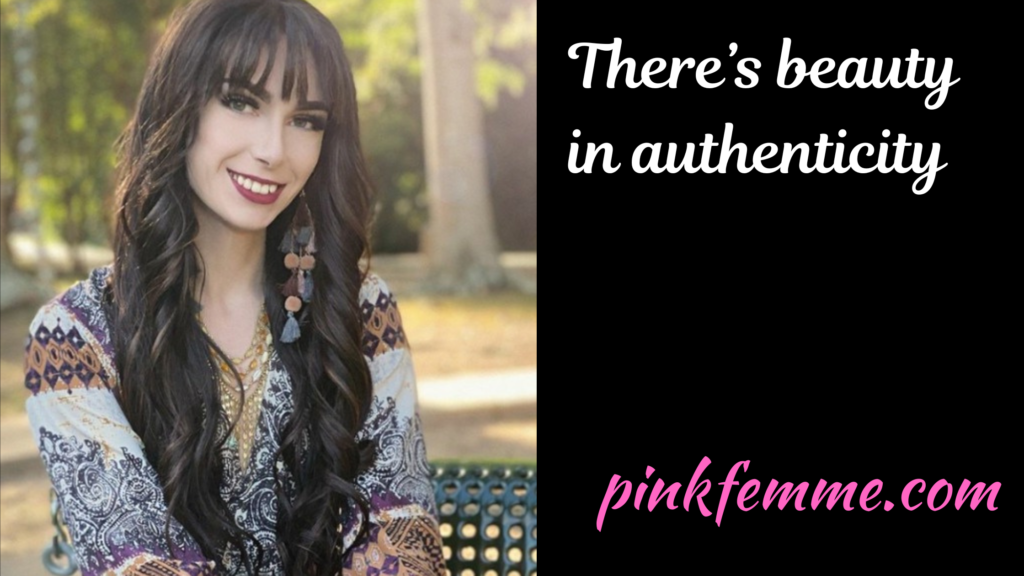
Imposter feelings grow strongest when you are constantly measuring yourself against standards that were never designed with you in mind. Each comparison, each correction, each moment of self-doubt reinforces the idea that your womanhood is conditional—something you have to earn rather than something you are allowed to inhabit. Over time, this can make even small choices feel loaded with anxiety.
What makes this particularly painful is that imposter feelings are incredibly isolating. You may look around and assume other women feel secure while you alone are struggling, not realizing how many are quietly questioning themselves too. When you believe you don’t belong, you’re more likely to silence yourself, minimize your needs, or stay in spaces that don’t truly honor you.
This is why it’s so important to name these dynamics. Womanhood cannot be reduced to one trait, one body, one presentation, or one experience. It is not a checklist or a performance. It is something lived from the inside out—felt in how you relate to yourself, how you move through the world, and how you make meaning of your life.
When you begin to recognize that your experience is valid simply because it is yours, imposter feelings start to loosen their grip. Belonging stops being something you chase and starts being something you allow. And that shift can change everything.
A Final Word
As you move forward, I want to gently remind you to be mindful of whose voices you allow into your inner world. Not every opinion deserves access to your heart. If someone’s words consistently leave you feeling smaller, ashamed, or as though you need to justify your existence, that voice is not guiding you toward growth—it’s pulling you away from yourself.
Growth feels different. It feels supportive, even when it challenges you. It feels like expansion, not contraction. You are allowed to protect your inner space, especially while your sense of self is still unfolding. Choosing distance from critical or dismissive voices is not avoidance—it’s an act of care.
Please hear this clearly: you are allowed to be exactly who you are, exactly as you are, right now. Your womanhood does not require refinement, approval, or permission. It is not something you need to earn through effort or performance. It already exists, simply because you do.
If you feel comfortable, I invite you to share your experiences below. Your story matters more than you may realize. Sometimes, the words we speak from our own healing become the lifeline someone else has been waiting for. And in sharing, we remind one another that none of us are alone on this path.
If you are looking for more lifestyle-related posts here on Pink Femme, you can find them all here.
If you enjoy reading transgender coming out stories or romance stories with a trans-positive element, take a look at my author page on Amazon where you will find all the novels that I have published so far.
Keep up to date with all my latest femme news with the fabulous Pink Femme Newsletter. Each Monday you’ll receive an email from me that will include a chapter from the novel that I am currently writing. I will also alert you to interesting information from articles that have not yet been published on Pink Femme. The Pink Femme Newsletter is the only place to see chapters from the novels before they are published. Sign up today: PINK FEMME NEWSLETTER.
Thank you for your visit to the Pink Femme website. I’m determined to keep all of the valuable information on here free for anyone to access. No pay-walls. That said, if you are able to help keep the lights on, so to speak, I would really appreciate your support. Here is the Pink Femme Patreon page with a really cheap support tier. Every little bit helps to cover the costs of keeping Pink Femme alive on the internet. Hugs to all of you.
When it comes to my choices for makeup and beauty products, I only use L’Oréal Paris (Available on Amazon). I have really sensitive skin and never once have I had any negative reaction to any L’Oréal product.
References
- American Psychological Association. (2015). Guidelines for psychological practice with transgender and gender nonconforming people. American Psychologist, 70(9), 832–864.
- American Psychological Association. (2021). APA Dictionary of Psychology (entries on gender identity, self-concept, and internalized stigma).
- Meyer, I. H. (2003). Prejudice, social stress, and mental health in lesbian, gay, and bisexual populations: Conceptual issues and research evidence. Psychological Bulletin, 129(5), 674–697. (Foundational paper on minority stress theory, frequently applied to trans populations.)
- Testa, R. J., Habarth, J., Peta, J., Balsam, K., & Bockting, W. (2015). Development of the Gender Minority Stress and Resilience Measure. Psychology of Sexual Orientation and Gender Diversity, 2(1), 65–77.
- Bockting, W. O., Miner, M. H., Swinburne Romine, R. E., Hamilton, A., & Coleman, E. (2013). Stigma, mental health, and resilience in an online sample of the U.S. transgender population. American Journal of Public Health, 103(5), 943–951.
- Lev, A. I. (2004). Transgender emergence: Therapeutic guidelines for working with gender-variant people and their families. Haworth Clinical Practice Press.
- Budge, S. L., Adelson, J. L., & Howard, K. A. S. (2013). Anxiety and depression in transgender individuals: The roles of transition status, loss, social support, and coping. Journal of Consulting and Clinical Psychology, 81(3), 545–557.
- Hidalgo, M. A., Ehrensaft, D., Tishelman, A. C., et al. (2013). The gender affirmative model: What we know and what we aim to learn. Human Development, 56(5), 285–290.
- Devor, A. H. (2004). Witnessing and mirroring: A fourteen stage model of transsexual identity formation. Journal of Gay & Lesbian Psychotherapy, 8(1–2), 41–67.
- Rogers, C. R. (1961). On becoming a person: A therapist’s view of psychotherapy. Houghton Mifflin. (Foundational work on authenticity, self-concept, and congruence, frequently applied in gender-affirming therapy.)